How to Pick a Dynasty Quarterback
Building a Dynasty · Part 9 of 12
How to Pick a Dynasty Football Fantasy Quarterback
Quarterbacks are notoriously hard to value in dynasty football. They have a premium value in the NFL, so they are often over-drafted. In dynasty leagues they can take a very long time to develop into an elite dynasty QB. It can take a solid 5 years before a QB really takes off, think Baker Mayfield for example. I for one had stopped investing early in rookie drafts in QBs because it was so hit or miss. The strategy I'd point you to is trading an aging star back at peak value for a young quarterback, and then picking up QBs in the 5th round or in free agency and letting them cook. You will cycle through a lot of names that don't work. For every Josh Allen there's a Trey Lance or a Zach Wilson who had every bit of the pedigree and never got there. If one in four sticks, you're ahead.
That was before I endeavored to create my Dynasty MatriX database and now it's much clearer to me how to strategize around investing in QBs. This article will explain the strategy and show you the statistics to back it up. You'll only get it here at Dynasty Football Fan! First, let's look at QB hit rates by decile. A hit here means the player reached a career tier of Starter or Star, and the population is every QB prospect in the 2001 through 2020 draft classes whose career is far enough along to grade.
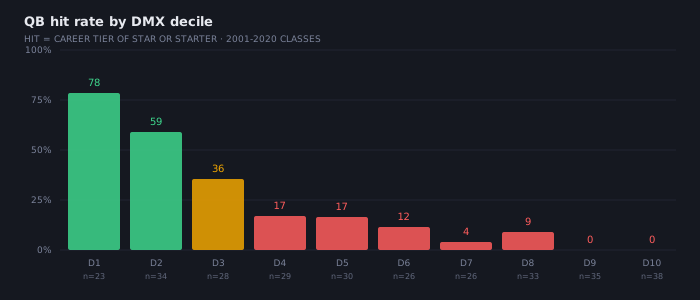
What you see here is a stark reminder that there are only 32 starting QB positions in the NFL and to be in the top half of that productivity curve is a difficult endeavor for a good prospect, let alone the poor ones. Here are some thoughts to consider on this chart:
- First, you only want to pick a QB if they are decile 3 or above. Decile 1 hits 78%, decile 2 hits 59%, decile 3 hits 36%. Then it falls off a shelf. Decile 4 is 17% and nothing below it gets back above 12%.
- Second, decile 1 QBs hit at 78% out of 23 prospects. That is the highest hit rate of any decile at any position in the whole database. If you're in the market for a QB and a decile 1 arm is on the board, that is the fastest way to build your QB room, full stop.
- Third, the old inversion is gone. When I first ran this the decile 2 number came in under decile 3 and I told you not to read into it. With another eight draft classes of results in the set, decile 2 now sits where it should, comfortably above decile 3. The sample was the problem, not the model.
- Fourth, look at the bottom of the chart. Deciles 9 and 10 have produced zero hits out of 73 prospects. Not a low rate. Zero. Decile 8 shows three, and they are Tony Romo, Ryan Fitzpatrick and Derek Anderson, all undrafted or late-round guys who found a situation. Those are the exceptions that prove the point, and none of them were predictable.
Put the top two deciles together and you get 67% out of 57 prospects. Everything from decile 3 down is 11% out of 245. That is the whole argument in two numbers.
With that in mind, let's take a look at how the hit rate moves with the raw DMX score rather than the decile bucket:
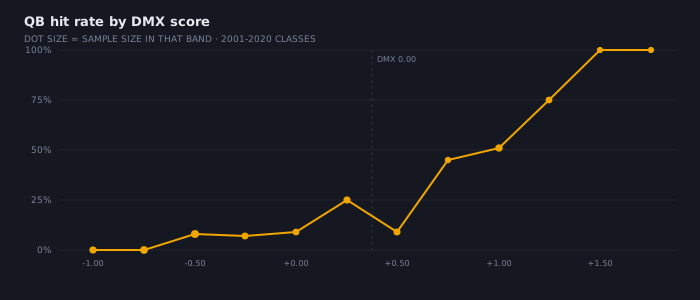
The line does almost nothing until 0.75 and then it takes off. Below 0.75 the hit rate sits in single digits and low teens. From 0.75 to 1.00 it is 45%. From 1.00 to 1.25 it is 51%. From 1.25 to 1.50 it is 75%. Above 1.50 every QB in the set hit, though there are only ten of them so don't build a religion on it. If you want one number to carry into your draft, 0.75 is the line in the sand.
What you'll also notice is that even above the line there are plenty of misses. QB choosing is hit and miss. We know that already, but it's worth emphasizing. For every Josh Allen or Jalen Hurts there is a Trey Lance or Zach Wilson. You can't expect a high level rookie DMX score to automatically produce fantasy points. To a certain extent it is a roll of the dice, even for the elite prospects. What the score buys you is better dice.
Here is how the current class sorts out on that scale:
| Player | Team | DMX | Decile |
|---|---|---|---|
| Fernando Mendoza | LV | 1.64 | 1 |
| Ty Simpson | LA | 1.18 | 2 |
| Drew Allar | PIT | 0.72 | 3 |
| Carson Beck | ARI | 0.70 | 3 |
| Cade Klubnik | NYJ | 0.57 | 4 |
| Cole Payton | PHI | 0.54 | 4 |
| Taylen Green | CLE | 0.36 | 4 |
2026 QB class, top DMX scores. Full board on the Draft Board.
Mendoza is the only decile 1 QB in the class and the only one clear of the 0.75 line by a comfortable margin. Simpson clears it too. Allar and Beck are sitting right on it, which is exactly the profile you take a swing at in the middle rounds rather than paying up for. Everyone below Klubnik is a late-round flier at best.
This leads me to the following conclusions when choosing QBs. My strategy based on this data is as follows:
- Don't pick QBs below the 3rd decile
- Within those deciles, focus on QBs above a 0.75 DMX score
- When possible, choose decile 1 QBs, especially if they fall into round 2
- Choose decile 2 and 3 QBs in the mid-rounds
- Treat decile 4 QBs as late-round fliers and nothing more
- Be patient. A QB investment can take 4-5 years to pay off, so don't get impatient with a decile 1-3 prospect and unload them before their time.
- If your QB room lacks depth, pick multiple qualifying players over successive years.
It's tough to trade your way into a deep QB roster, you'll end up thinning out your RB or WR room which is a dangerous proposition. The best value is to hold onto your elite prospects if you have any. If you don't, trade for mid-level depth for short periods if you need it (think Sam Darnold or Geno Smith) and then invest the lower end of your roster with QBs that you can stash for 4-5 years that fit the criteria set forth above. They won't all hit, but if you have 3 or 4, at least two should hit and that will be enough to give you the depth you need at the QB position. With QB careers going well into the late 30's these days, this strategy can pay dividends for well over a decade in dynasty leagues.