Dynasty Tight End Strategy
Building a Dynasty · Part 11 of 12
Dynasty Tight End Strategies using DMX
In the Dynasty MatriX database, which ranks prospects by DMX score going back to 2001, it is very clear that at the tight end position there are haves and have nots. To prove my point, here is the hit rate by decile for tight ends. A hit means the player reached a career tier of Starter or Star, across every TE prospect in the 2001 through 2020 draft classes.
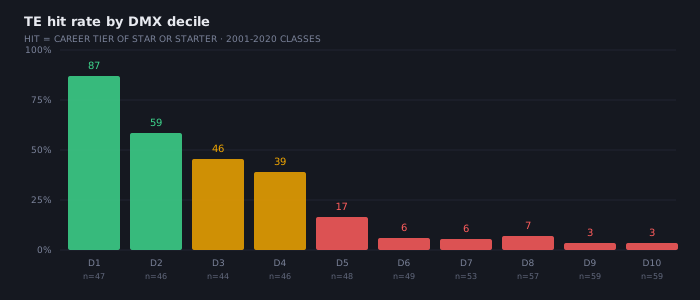
When we break tight ends out by decile, several things become obvious:
- Decile 1 hits at 87% out of 47 prospects. That is the single best decile-1 number of any offensive position in the database.
- Decile 2 hits at 59%, decile 3 at 46%, decile 4 at 39%. Put the top two together and it's 73% out of 93 prospects.
- The cliff is after decile 4, not after decile 2. Decile 5 drops to 17% and deciles 6 through 10 sit between 3% and 7%. Below decile 4 you are drafting noise.
- Deciles 3 through 10 combined hit 15% out of 415 prospects, against 73% for deciles 1 and 2.
That fourth-decile line is a change from how I used to describe this. My original take was to draft decile 1 and 2 tight ends and ignore everything else. The data with another eight classes in it says the useful line is a bit lower. Deciles 3 and 4 hit at 46% and 39%, which is not elite but is a perfectly good return on a mid-round rookie pick. What you cannot do is reach into decile 5 and below, where the whole population produces about one hit in twenty.
Digging deeper, here is the hit rate against the raw DMX score:
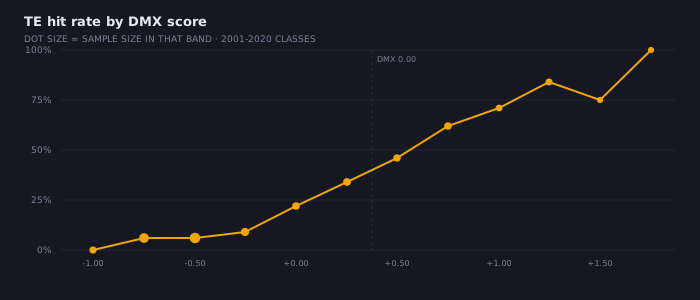
Every band below -0.25 sits at 6% or lower, and the two lowest bands have produced no hits at all out of 36 prospects. From 0.00 to 0.25 it's 22%, then 34%, 46%, 62%, 71%, 84% as you climb. Tight end is the position where the score does the most work, because the position asks the least of situation and the most of the player. A tight end who can run and catch will eventually be on the field somewhere.
Which tight ends qualify
The big question then becomes, which tight ends are decile 1 and 2? Below is the list of decile 1 and 2 tight ends who played a regular season snap in 2025, ranked by DMX score. You'll notice all ages are represented, so this ranking is simply by score to highlight who is currently available. Some of these are over the hill, some seem to never quite put it together, and some are on the cusp of breaking out. Whether you have a veteran team and can use an older TE for depth, you're looking for young but unknown players on the waivers, or you want rookies and second year guys to invest in, this is the subset of players you should be looking at.
| Player | Team | Class | DMX | Decile |
|---|---|---|---|---|
| Kyle Pitts | ATL | 2021 | 2.34 | 1 |
| Noah Fant | NO | 2019 | 2.14 | 1 |
| Sam LaPorta | DET | 2023 | 1.96 | 1 |
| T.J. Hockenson | MIN | 2019 | 1.91 | 1 |
| Mike Gesicki | CIN | 2018 | 1.85 | 1 |
| Colston Loveland | CHI | 2025 | 1.81 | 1 |
| David Njoku | LAC | 2017 | 1.70 | 1 |
| Trey McBride | ARI | 2022 | 1.68 | 1 |
| Tyler Warren | IND | 2025 | 1.63 | 1 |
| Evan Engram | DEN | 2017 | 1.62 | 1 |
| Ben Sinnott | WAS | 2024 | 1.61 | 1 |
| Brock Bowers | LV | 2024 | 1.60 | 1 |
| Cole Kmet | CHI | 2020 | 1.48 | 1 |
| Michael Mayer | LV | 2023 | 1.45 | 1 |
| Josh Oliver | MIN | 2019 | 1.43 | 1 |
| Mason Taylor | NYJ | 2025 | 1.41 | 1 |
| Terrance Ferguson | LA | 2025 | 1.38 | 1 |
| Dalton Kincaid | BUF | 2023 | 1.29 | 1 |
| Greg Dulcich | MIA | 2022 | 1.21 | 1 |
| Zach Ertz | WAS | 2013 | 1.15 | 1 |
| Hunter Henry | NE | 2016 | 1.12 | 1 |
| Elijah Arroyo | SEA | 2025 | 1.12 | 2 |
Decile 1 and 2 tight ends with 2025 regular season snaps, by DMX score.
Notice who isn't on it. If a tight end you're being offered doesn't appear here or in the deciles just below, it doesn't mean you can't roster him. It does mean the history is stacked against him, and you shouldn't pay anything real to find out.
The current class
Here is where the 2026 rookie tight ends land:
| Player | Team | DMX | Decile |
|---|---|---|---|
| Kenyon Sadiq | NYJ | 2.13 | 1 |
| Eli Stowers | PHI | 1.60 | 1 |
| Sam Roush | CHI | 1.35 | 1 |
| Eli Raridon | NE | 1.01 | 2 |
| Max Klare | LA | 0.81 | 2 |
| Marlin Klein | HOU | 0.78 | 2 |
| Oscar Delp | NO | 0.62 | 3 |
| Tanner Koziol | JAX | 0.58 | 3 |
| Will Kacmarek | MIA | 0.56 | 3 |
| Justin Joly | DEN | 0.53 | 3 |
2026 rookie TE class, top DMX scores. Full board on the Draft Board.
Sadiq at 2.13 is the kind of score that shows up once every few classes at this position. Stowers and Roush both clear decile 1. That's three qualifying tight ends in one class, which is unusual, and if you need the position this is the year to solve it. Raridon, Klare and Klein round out the decile 2 group. Everything from Delp down is a mid-round pick at a 46% historical rate, which is fine value if you aren't paying up for it.
It's clear from the numbers above that decile 1 and 2 prospects should be invested in long term, deciles 3 and 4 are worth mid-round picks, and anything below that should be ignored for drafting purposes until a player has a couple of years to prove he's up to NFL standards of production. Happy hunting.